Can You Put Shower Panels Over Tiles? Yes, But Not Always

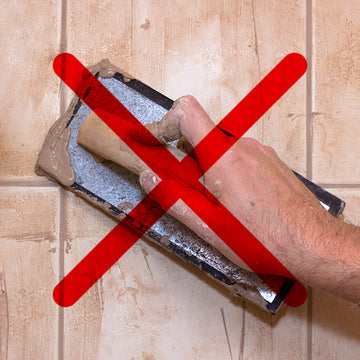
The tiles are ugly but they're solid. Stripping them means a skip, a week of dust, and probably a plasterer once half the wall comes off with them. So the obvious question is whether you can just panel straight over the top and be done by Sunday.
Yes, in most cases you can. If the existing tiles are firmly bonded, reasonably flat, and cover the full area you're panelling, wall panels go straight over them and you skip the messiest part of the job.
The cases where you shouldn't are specific and worth knowing before you buy anything. Half-tiled walls are the big one. Here's how to tell which situation you're in.
Quick Takeaways
- Panelling over sound, full-height tile is straightforward and saves the strip-out entirely.
- Half-tiled walls are the exception. The step where the tiling stops causes more trouble than removing it.
- Tap across the whole wall first. Anything that sounds hollow isn't bonded and has to come off.
- Adhesive won't flatten a wall. It fills small variations, not a wall that's genuinely out of true.
- Going over tile adds depth, so check reveals, architraves and your shower valve plate before you start.
Can You Put Shower Panels Over Tiles?
Yes, provided the tiles are secure, level and in good condition. That's the standard condition every panel manufacturer sets, and it's doing more work than it looks.
Panels are bonded to whatever is behind them with adhesive, and they follow that surface. They don't span across dips or bridge a step. So the question isn't really "can panels go over tile", it's "is this particular tiled wall a good surface to bond to".
Four things decide it:
- Is every tile firmly stuck? One drummy tile becomes a loose panel later.
- Is the wall reasonably flat? Small variations are fine. A wall that's visibly bowed isn't.
- Does the tile cover the whole area you're panelling? This is the one that catches people out.
- Is the detailing simple? A flat rectangular run around a bath is easy. Panelling around a basin, a WC and three pipe penetrations is a different job.
Get four yeses and panelling over the top is the sensible choice. Get a no on any of them and it's worth reading the next two sections before you order.
When Panelling Over Tiles Works
The ideal case is a full-height tiled wall in sound condition with simple, straight runs. That's most shower enclosures and most over-bath areas, which is why the technique is so popular.
Good candidates
- Full-height tiling, floor to ceiling or tray to ceiling
- Tiles that are firmly bonded with no movement
- Flat walls, or close to it
- Simple rectangular runs with few penetrations
- Tile you'd otherwise have to pay someone to remove
Problem candidates
- Half-tiled or dado-height walls
- Any tile that sounds hollow when tapped
- Visibly bowed or badly out-of-true walls
- Lots of pipework, a basin and a WC in a small run
- Tight tolerances at a door reveal or window
Where it works, it works well. You keep the room usable, you skip the skip, and you avoid the plaster repairs that follow a strip-out. That's the whole reason people choose panels over retiling in the first place.
When You Should Remove the Tiles Instead
Sometimes stripping is genuinely the better call, and the trades are right about it. The clearest case is a half-tiled wall, where the step at the top of the tiling causes more work than removal would.
Strip the tiles if any of these apply
- The wall is half-tiled. Panelling over it leaves a step where the tiles stop. You then either pack out the untiled section to match, or accept a visible ridge. Packing out with ply or board is more work than knocking the tiles off and making good.
- Any tile moves or sounds hollow. A panel bonded to a loose tile is a panel bonded to nothing. If it's a handful of tiles, cut them out and fill. If it's widespread, strip the lot.
- The wall is genuinely out of true. Adhesive fills millimetres, not centimetres. A bowed wall will telegraph straight through a large-format panel and the joints won't close properly.
- The detailing is awkward. If the run includes a basin, a WC, pipe penetrations and a couple of internal corners, the extra depth over tile makes every one of those harder to finish neatly.
The DIY forums are blunt about this and they have a point. The usual line is that scraping tiles off takes very little time compared with fitting panels properly, so leaving them on to save an afternoon can be a false economy.
One thing worth weighing: removal often takes the plasterboard face with it, which means patching or replacing sections of board. That's a real cost, and it's why panelling over sound tile is attractive. The judgement is whether you're avoiding a genuine job or just postponing a problem.
How Do You Check If Your Tiles Are Sound?
Four checks, and they take about ten minutes. Do all of them before you order panels, not after they arrive.
-
Tap across every tile
Use your knuckle or the handle of a screwdriver. A well-bonded tile sounds solid and dull. A hollow or drummy note means the adhesive has let go behind it. Mark anything hollow with a pencil as you go.
-
Push and check for movement
Press firmly at the corners of a few tiles, especially near the bath edge and around any pipework. Any flex or creaking means it needs to come off.
-
Hold a straight edge against the wall
A long spirit level or a straight batten will show you the dips and bows. Move it vertically and horizontally. Small gaps are fine. If you can fit a finger behind it, you've got a flatness problem to solve first.
-
Measure the step at the tile edge
If the tiling stops partway up, measure how far it stands proud of the wall above. That's the gap you'd need to pack out, and knowing the number usually makes the strip-or-panel decision for you.
Also worth doing while you're there: clean off soap residue and old sealant. Adhesive needs a clean surface, and silicone residue around a bath or tray is the usual reason a panel refuses to sit flat.
What Do You Put Behind Shower Wall Panels?
In an over-tile installation, the existing tile is the substrate. You don't add anything behind the panel. The waterproofing comes from the panel itself and the sealed joints, not from a hidden layer.
This is where panels differ from tiling in a way that's worth understanding. In a tiled shower, the tile isn't the waterproof layer. Grout is porous, so the real barrier is a tanking membrane behind everything, which is why a properly built tiled shower is more work than it looks.
The waterproofing is the panel plus the seal
PVC is waterproof as a material rather than surface coated, so water can't pass through the face of a panel the way it soaks into grout. What's left is the joints and edges, and those are sealed with silicone as the panels go up.
Which means the sealing is the job. Not an afterthought once the wall is finished.
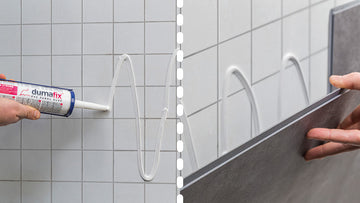
On a bare stud wall you'd fix panels to moisture-resistant board first. Over existing sound tile, that layer already exists. Duma's DIY installation guide sets out the sequence: get the surface clean, dry and level, fix your trims, then run adhesive and work along the tongue-and-groove joints.
What Are the Disadvantages of Shower Panels?
Four, and none of them is about whether the panel keeps water out. They're about what happens if you get the fitting wrong or buy the wrong product.
The genuine drawbacks
- Adhesive grabs quickly. Once a panel is bonded and the next one is locked into it, swapping it out is awkward. Dry-fit and measure twice.
- Cheap cladding dents. Thin ribbed panels with air chambers mark from a knock and the mark is permanent. Better-built panels are far more resilient, and the difference isn't obvious from a listing photo.
- Panels are for walls. They aren't a floor or a shower tray. You'll need a prefabricated tray or base as a separate purchase.
- No small-format looks. If you want mosaic or metro with visible joints, large panels can't imitate that convincingly.
Does Panelling Over Tiles Affect Depth and Trims?
Yes, and it's the detail most guides skip. You're adding the tile thickness plus the panel thickness plus the adhesive bed, and that stack has to work everywhere the wall meets something else.
| Where to check | What to look for |
|---|---|
| Shower valve plate | Does the escutcheon still sit flush, or does the spindle now sit too deep? |
| Window reveal | Is there enough reveal left, or does the panel foul the frame? |
| Door architrave | Will the panel run into the architrave and need scribing? |
| Bath or tray edge | Does the panel land on the lip cleanly for sealing? |
| Internal corners | Do your corner trims accommodate the extra build-up? |
| Sockets and switches | Do faceplates still sit flat and safely? Electrics near wet areas need a qualified electrician. |
None of these is a reason not to panel over tile. They're the things that turn a smooth weekend into an irritating one when you find them halfway through.
Are Shower Panels Waterproof, and Do They Leak?
The panels themselves are waterproof. When a panelled shower leaks, it's almost always a seam, an edge or a trim that wasn't sealed properly, not water passing through the panel.
Duma's Maxi shower panels and Dumawall Plus tiles are both specified as fully waterproof and intended for bathrooms, shower enclosures and other wet areas. Because the material itself is waterproof rather than surface coated, a surface scratch doesn't create a route for water in the way a failed grout line does.
The failure points are predictable, which is useful because it means they're avoidable:
- Tongue-and-groove joints that weren't siliconed as the panels went in
- The junction where panels meet the tray or bath lip
- Internal and external corner trims
- Cut edges around pipework and valves
Run silicone into the joint as you fit each panel rather than trying to seal from the front afterwards. Doing it in the right order is most of the job.
Can You Use Shower Panels in a Wet Room?
On the walls, yes. The floor is a different matter and it isn't a panel job.
Wall panels suit wet rooms well because there's no grout to maintain in a space that stays damp. But a wet room's floor needs proper tanking, a fall to the drain and a correctly detailed waste, and that's structural work rather than a surface finish. Get that wrong and no wall covering will save you.
If you're converting to a full wet room rather than panelling an existing enclosure, get the floor specified and installed by a qualified trade, then panel the walls. Same for anything involving electrics in a shower zone.
Work out what you need
Enter your wall measurements and the calculator sorts panels and trims.
Large format, fewer joints
Maxi Shower Panels
£53.70 per panel, covers 2.4m²
- 1000 x 2400 x 10mm
- 10mm uPVC
- Tongue & groove
- 20+ finishes
One panel covers a typical shower wall with a single visible joint, which is part of why large format reads less like cladding. For tile-format walls, Dumawall Plus is £127 per pack of 8 covering 1.95m², with a 10 year warranty.
Shop Maxi panelsDelivery 2 to 7 working days, UK mainland
Shower Panels Over Tiles: The Bottom Line
Panelling over existing tile is a legitimate shortcut, not a bodge, as long as the wall behind is worth bonding to. Full-height, firmly stuck, reasonably flat tile is a good surface and going over it saves you the worst part of a bathroom refit.
Half-tiled walls, hollow tiles and bowed walls are where it goes wrong, and in those cases the people telling you to strip them off are giving you good advice. Ten minutes with a straight edge and your knuckles will tell you which one you've got.
Shower Panel FAQs
How can I cover my shower tiles without removing them?
Bond wall panels straight over them. Check the tiles are firmly stuck and reasonably flat first, clean off soap residue and old sealant, then fit trims and panels with panel adhesive, sealing each joint as you go.
What shower panels go over existing tile?
Most PVC wall panels will, including large-format Maxi panels and tile-format Dumawall Plus. The panel type matters less than the condition of the tile underneath.
What are the disadvantages of shower panels?
Adhesive grabs fast so mistakes are hard to reverse, cheap hollow cladding dents easily, panels are for walls rather than trays, and small-format tile looks like mosaic aren't achievable.
What do you put behind shower wall panels?
Over existing sound tile, nothing extra. The tile is the substrate. On a bare stud wall you'd fix to moisture-resistant board first. The waterproofing is the panel plus sealed joints, not a hidden membrane.
How long do shower panels last?
PVC doesn't degrade the way grout does, so panels don't need the resealing cycle a tiled wall does. Dumawall Plus carries a 10 year warranty. Lifespan in practice depends far more on how well the joints were sealed than on the panel.
Do shower panels leak?
The panels don't. Leaks trace back to unsealed joints, the junction with the tray or bath, or cut edges around pipework. Siliconing each joint as the panel goes in is what prevents it.
Check the finish before you commit
Order samples and see them in your own bathroom light.
Order samplesSources
- Duma Tiles product specifications, FAQs and DIY installation guide, checked 5 August 2026